E-Bike Quota System – District, Gender, Disability and Rural Priority Explained

The Punjab E-Bike Scheme has attracted huge interest from students across the province. Applications were open from 5 September to 4 October 2026, and the window has now closed. With 100,000 bikes available, many applicants want to know how selection is shared fairly.
Registrations reached 1,149,058 by 1 October 2026, including 222,101 female applicants. By the deadline, total registrations had passed 1.3 million. This large gap between applicants and bikes is why a quota system matters.
This guide explains district, gender, disability and rural priority in simple terms. It does not promise selection to any applicant. For your own status, always check the official portal, bikes.punjab.gov.pk, especially after balloting announced for 4 November 2026.
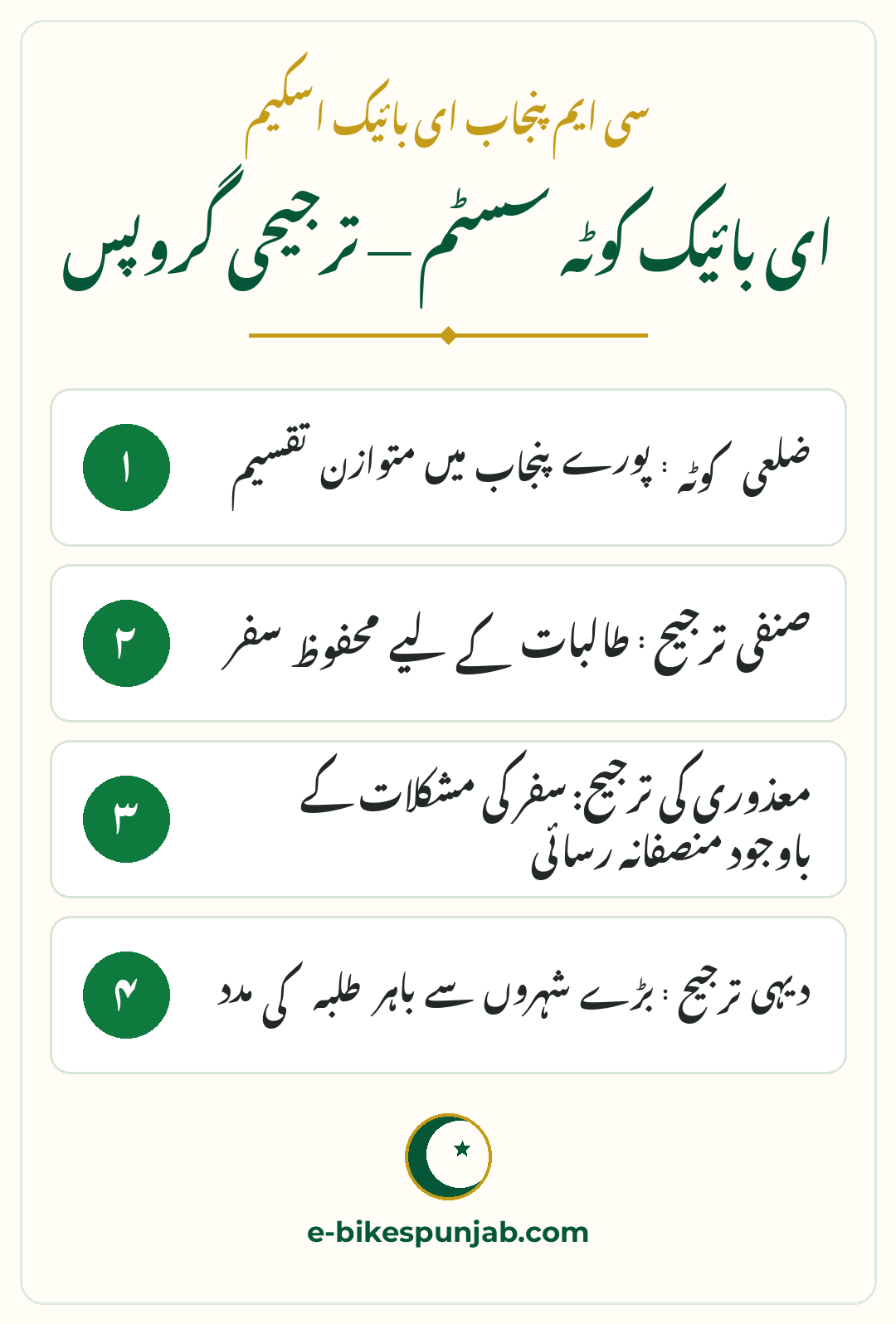
What Is the E-Bike Quota System?
A quota system divides a limited number of bikes among different groups. It aims to spread opportunity across districts and priority groups, rather than giving everything to one area or group. This approach is important when demand is far higher than supply.
The quota idea is not the same as a guarantee. A quota sets aside a share for a group, but selection within that group still depends on eligibility, verification and balloting. Applicants should understand both parts: the share for their group, and the selection process inside it.
- Quotas help distribute bikes across Punjab, not only in large cities.
- They give defined priority to groups that may otherwise face barriers.
- They work alongside verification, so only eligible applicants move forward.
- They do not remove the need for balloting when applicants exceed bikes.
Scheme at a Glance
The table below summarises the confirmed scheme facts used in this guide. Keep these numbers in mind while reading about quotas. They show the scale of the programme and why fair distribution is essential.
| Scheme Fact | Detail |
|---|---|
| Total bikes | 100,000 |
| Application window | 5 September to 4 October 2026 (closed) |
| Registrations by 1 October | 1,149,058, including 222,101 female applicants |
| Registrations by deadline | More than 1.3 million |
| Balloting announced for | 4 November 2026 |
| Distribution from | 5 November 2026 |
| Bike price | Rs 199,000 |
| Government subsidy | Rs 90,000 |
| Student payment | Rs 109,000 over 36 months at Rs 3,028 per month |
| Markup and down payment | 0% markup, no down payment |
The government also covers insurance, markup and registration costs. Selected students receive a free helmet and safety rod, plus two days of training. Bikes are pink for girls and black for boys.
District Quota: Why Your District Matters
Punjab has many districts, and student numbers differ from district to district. A district quota aims to ensure that bikes are not concentrated only in a few big cities. Each district should get a fair share based on its applicant pool and programme rules.
This does not mean every district gets the same number of bikes. A larger district with more eligible students may receive more bikes than a smaller district. The key idea is balance: wide coverage across the province, not concentration in one place.
Applicants should therefore check the district details they entered in their application. An error in district information could affect how an application is grouped. If you suspect an error, follow the official correction guidance on the portal and keep proof of any update.
- Apply and verify with your correct district of study or residence, as required.
- Do not use another district address only to improve your chances.
- Keep your application reference safe for district-wise checks later.
- Follow only district information published on bikes.punjab.gov.pk.
Gender Priority: What Female Applicants Should Know
Female participation in this scheme has been strong. By 1 October, 222,101 female applicants had registered, out of 1,149,058 total registrations. This shows that the scheme is reaching a large number of female students.
Gender priority recognises that female students may face transport barriers that male students do not. Safe, affordable transport can affect attendance, confidence and access to education. A defined share or priority for female applicants helps address that gap.
If you are a female applicant, keep your documents ready for verification. Bank of Punjab verification is part of the scheme process, so your records should match your application. Do not share your login details with anyone offering selection help.
Disability Priority: Support for Students with Disabilities
Disability priority is designed to give fair access to students who face extra travel challenges. For many students with disabilities, public transport can be difficult, costly or unsafe. An e-bike can offer greater independence, if it suits the student’s needs and safety requirements.
Applicants in this group should ensure that their disability status, where required, is recorded correctly in the application. Supporting documents may be needed during verification. Keep originals safe and carry clear copies when asked.
Priority does not mean automatic selection without checks. Eligibility, documents and balloting rules still apply. The purpose of priority is fair consideration within the system, not a bypass of verification.
- Record disability status accurately, only if it applies to you.
- Keep supporting documents ready for verification.
- Attend training and learn safe riding for your own needs.
- Ask the delivery team about safety kit fitting and riding guidance.
Rural Priority: Reaching Students Beyond Big Cities
Students in rural areas often travel longer distances to reach college or university. Transport options may be limited, and daily travel can be expensive. Rural priority aims to ensure that these students are not left behind by city-focused distribution.
A rural applicant may face different challenges from an urban applicant. These include fewer buses, longer routes and higher travel time. A fair quota system should reflect those realities, while still applying the same eligibility checks.
Do not assume that a rural address alone guarantees selection. It is one priority factor within a larger system. Verification, eligibility and balloting still decide the final outcome for each applicant.
An applicant may belong to more than one priority group, such as a female student from a rural district. This does not mean double selection. The rule of one bike per family still applies, and balloting and verification decide the final outcome.
Teachers use a separate track at ptf.punjab.gov.pk, not the student quota pool. Students should stay on bikes.punjab.gov.pk.
PITB E-Balloting and Bank of Punjab Verification
Balloting is announced for 4 November 2026, and PITB e-balloting is used for the draw. E-balloting is designed to make selection transparent and system-based, rather than manual. This matters when more than 1.3 million people apply for 100,000 bikes.
Bank of Punjab verification is also part of the process. It checks applicant details before final selection and delivery. Applicants should ensure that their bank and identity details match their application, and respond only to official messages.
At the time of writing, readers must confirm their own status on bikes.punjab.gov.pk. Do not claim or accept that an official selection list is out unless the official portal confirms it. Forwarded lists, screenshots and social media claims are not proof.
- Check your status only on bikes.punjab.gov.pk.
- Do not pay anyone who promises selection or quota approval.
- Keep your application number and CNIC details private.
- Save official messages and receipts.
A quota improves fairness, but it cannot give a bike to every applicant. With more than 1.3 million registrations for 100,000 bikes, most applicants will not be selected in this phase. It also does not override eligibility or the balloting result.
Applicant Checklist: Quota, Verification and Delivery
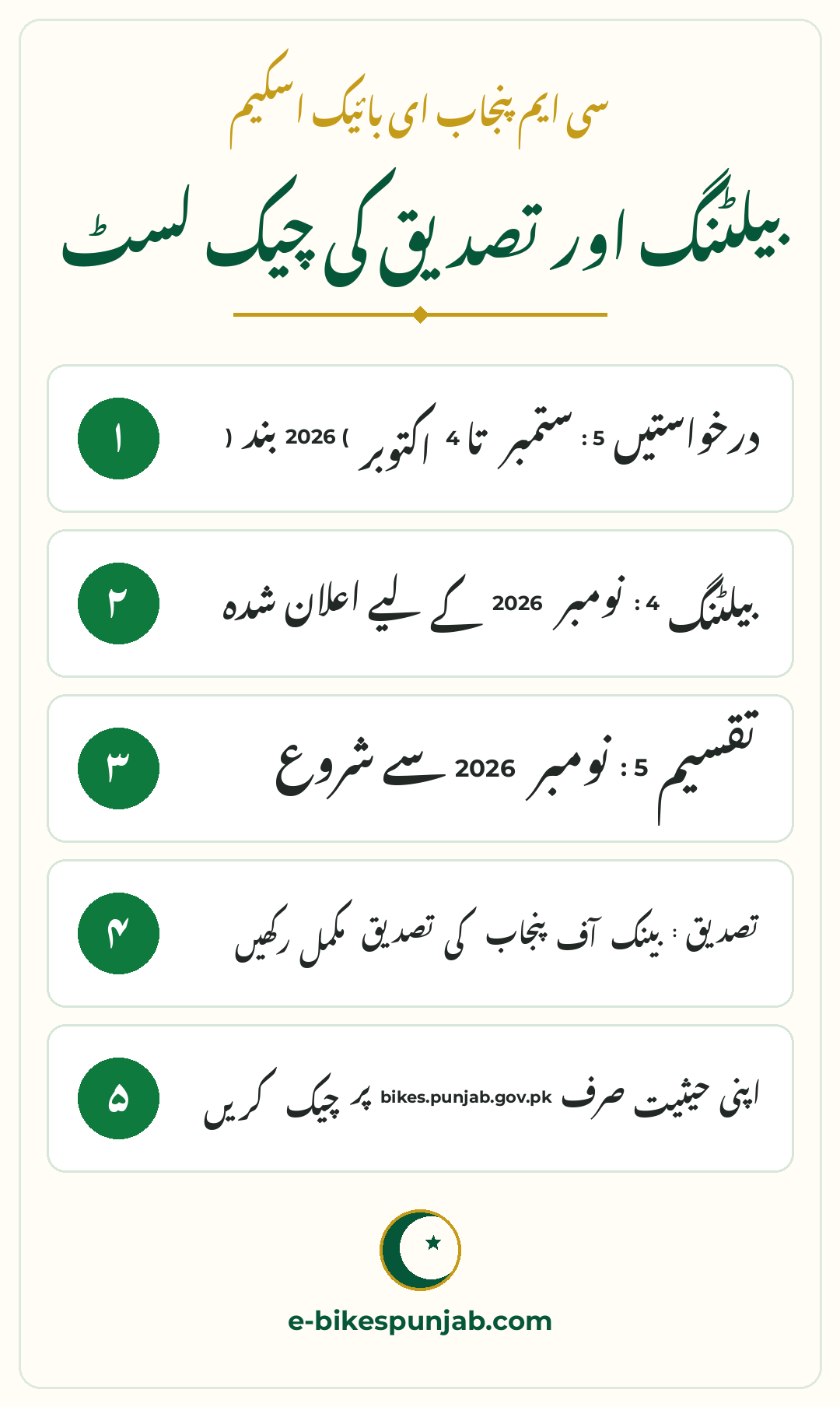
Use this checklist to stay ready while balloting and distribution proceed. Complete each step only when you have verified it yourself. Do not rely on rumours for any item below.
- Application details checked: district, category and personal information.
- Documents ready for Bank of Punjab verification.
- Status checked on bikes.punjab.gov.pk after 4 November 2026.
- One bike per family rule understood and respected.
- Helmet, safety rod and two-day training plan noted for selected students.
Frequently Asked Questions
Does my district decide whether I get a bike?
Your district affects how your application is grouped, but it does not decide selection alone. Eligibility, verification and balloting also matter. Check your district details and your official status on the portal.
Do female applicants get automatic selection?
No, gender priority improves fair access, but it is not automatic selection. Female applicants still go through verification and balloting. The strong female registration figure of 222,101 by 1 October shows high demand within this group as well.
Where can I confirm balloting and selection?
Confirm everything on bikes.punjab.gov.pk. Balloting is announced for 4 November 2026, and distribution is planned from 5 November 2026. Do not trust unofficial lists or paid agents.
Conclusion
The quota system is about fairness in a programme with very high demand. District coverage, gender priority, disability support and rural priority each address a real barrier. Together, they help spread 100,000 bikes more fairly across Punjab.
Your best step is simple: keep your details correct, complete verification honestly and check only the official portal. If you are selected, prepare your licence, attend training and ride safely. If you are not selected, keep your records safe for any future phase announced officially.