E-Bike vs Petrol Bike Running Cost 2026: Per Kilometre Comparison for Students
For a student who travels to college every day, the real question about a bike is not only its price. The real question is how much it costs to run it every single kilometre. A bike that looks cheap at the time of buying can become expensive if it needs petrol every few days, while a bike with a higher starting price can turn out cheaper if its daily running cost is very low.
Under the Punjab e-bikes scheme, students can get an electric bike on easy monthly installments. An e-bike does not need petrol at all. A full charge costs only a small amount, while a petrol bike needs petrol for every trip at Rs 322 per litre. Divide the cost of one full charge or one litre of petrol by the distance it covers, and you get the per-kilometre cost. Every per-km figure here is a calculated estimate from the verified inputs stated in this article.
How Per-Kilometre Cost Works
Per-kilometre cost is a simple idea. You take the money you spend for one full charge or one litre of petrol, and you divide it by the distance that charge or litre gives you. If a student travels 20 km in a day, the daily cost is the per-km cost multiplied by 20. The price of a bike is a one-time or installment cost, while the per-km cost is a daily cost that keeps coming for years. That is why the E-Bike vs Petrol Bike Running Cost gap matters over a month.
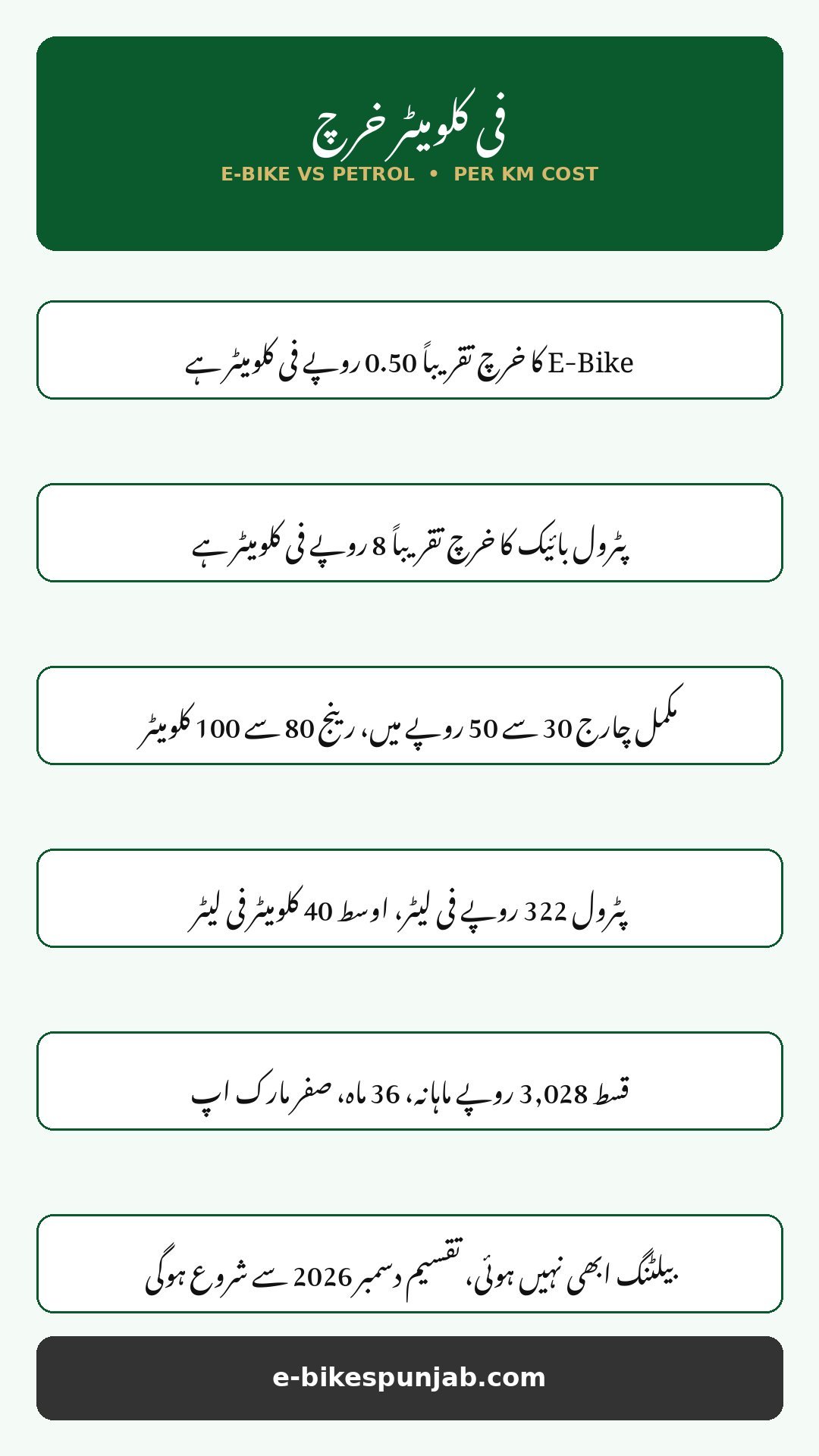
- E-bike input: a full charge costs Rs 30 to Rs 50, and one full charge gives a range of 80 to 100 km.
- Petrol bike input: one litre of petrol costs Rs 322, and one litre gives about 40 km of travel.
- Calculation method: cost of one charge or one litre divided by the distance it covers gives the per-km cost.
- Result type: every per-km figure in this article is a calculated estimate from these verified inputs, not a fixed official rate.
E-Bike vs Petrol Bike Running Cost Per Kilometre Table
The table below is the core of this article. It places the e-bike and the petrol bike side by side on the same basis, so the difference is clear at a glance. The per-km figures are calculated estimates from the inputs above.
| Item | E-Bike | Petrol Bike |
|---|---|---|
| Fuel or charge cost | Rs 30-50 per full charge | Rs 322 per litre |
| Distance covered | 80-100 km per charge | About 40 km per litre |
| Per-km cost | About Rs 0.40-0.60 per km* | About Rs 8 per km* |
| Cost for 20 km a day | About Rs 8-12 per day* | About Rs 160 per day* |
| Cost for 30 km a day | About Rs 12-18 per day* | About Rs 240 per day* |
| Charging or refuelling | Charge at home, 3-4 hours | Petrol pump visit needed |
* All per-km and daily figures in the table are calculated estimates from the verified inputs above: e-bike full charge Rs 30-50 for 80-100 km, and petrol at Rs 322 per litre for about 40 km per litre.
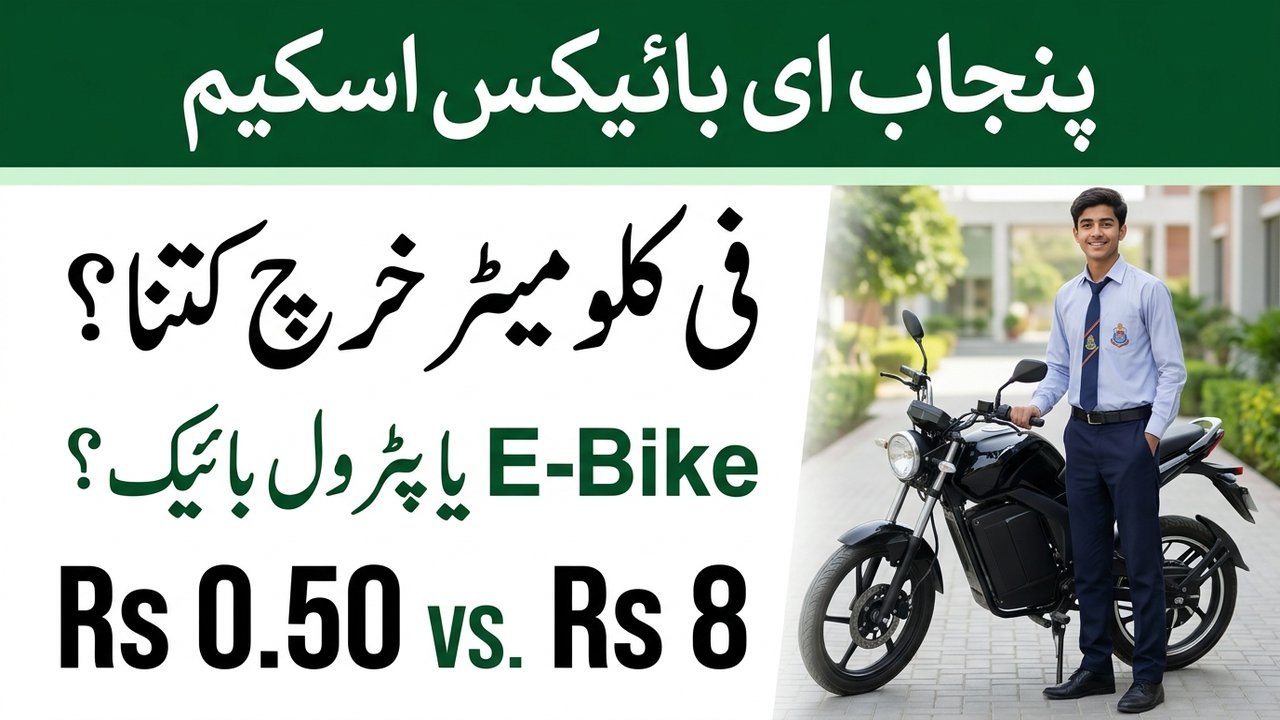
The table shows a very large gap. The e-bike costs roughly Rs 0.40 to Rs 0.60 per km as a calculated estimate, while the petrol bike costs roughly Rs 8 per km as a calculated estimate. In simple words, the petrol bike costs about 13 to 20 times more per kilometre for fuel alone. That gap is the main point of the E-Bike vs Petrol Bike Running Cost comparison, and it stays large even if the exact range or charge cost changes a little for one student.
E-Bike Per Kilometre Cost Explained
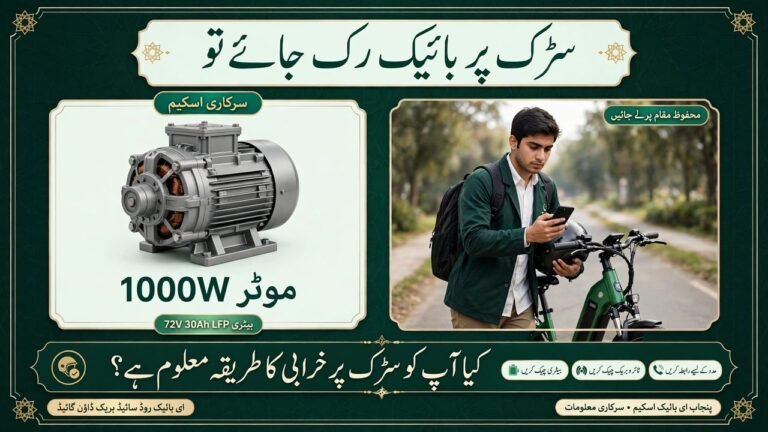
The e-bike in the Punjab scheme has a 72V 30Ah LFP battery with a capacity of 2.16 kWh and a 1000W motor. Its top speed is 50 to 55 km/h, which is suitable for daily travel to college and back. The bike gives a range of 80 to 100 km per full charge, and the charging time is 3 to 4 hours. A full charge costs Rs 30 to Rs 50.
To find the per-km cost, the charge cost is divided by the range. At the low end, Rs 30 divided by 100 km gives Rs 0.30 per km. At the high end, Rs 50 divided by 80 km gives Rs 0.625 per km. The middle of that range is about Rs 0.40 to Rs 0.60 per km, and this article uses that middle range as the working estimate. Students who want more detail can read the battery, charging cost and range guide, which explains the same figures in more detail.
For a student who travels 20 km a day, the e-bike running cost is about Rs 8 to Rs 12 per day as a calculated estimate, or about Rs 208 to Rs 312 a month over 26 college days. For 30 km a day, it is about Rs 312 to Rs 468 a month as a calculated estimate. The bike can be charged at home, comes with a free helmet and safety rod, and students get 2-day riding training. Girls get free driving training as well.
Petrol Bike Per Kilometre Cost Explained
A petrol bike needs petrol for every kilometre it travels. The petrol price used in this article is Rs 322 per litre, verified on 21 November 2026. At an average of about 40 km per litre, one litre gives about 40 km of travel. To find the per-km cost, Rs 322 is divided by 40, which gives Rs 8.05 per km. This article rounds that to about Rs 8 per km and labels it as a calculated estimate.
For a student who travels 20 km a day, the petrol cost is about Rs 160 per day as a calculated estimate, or about Rs 4,160 a month over 26 college days. For 30 km a day, it is about Rs 240 per day, or about Rs 6,240 a month as a calculated estimate. A petrol bike also needs a petrol pump visit whenever the tank runs low, and if the petrol price rises, the per-km cost rises at once.
Monthly Running Cost For Different Daily Distances
Not every student travels the same distance, so the monthly cost differs even though the per-km cost is the same. The examples below use 26 college days in a month. The longer the daily distance, the larger the saving, because every extra kilometre costs about Rs 8 on a petrol bike as a calculated estimate, but only about Rs 0.40 to Rs 0.60 on an e-bike as a calculated estimate.
- 10 km a day: e-bike about Rs 104-156 a month, petrol bike about Rs 2,080 a month, both as calculated estimates for 26 days.
- 20 km a day: e-bike about Rs 208-312 a month, petrol bike about Rs 4,160 a month, both as calculated estimates for 26 days.
- 30 km a day: e-bike about Rs 312-468 a month, petrol bike about Rs 6,240 a month, both as calculated estimates for 26 days.
- 40 km a day: e-bike about Rs 416-624 a month, petrol bike about Rs 8,320 a month, both as calculated estimates for 26 days.
- Key lesson: the per-km gap stays the same, but the monthly saving grows as the daily distance grows.
Monthly Installment Is Separate From Running Cost
Students should not mix the monthly installment with the running cost. The installment pays for the bike itself over 36 months, while the running cost pays for the electricity or petrol used each day. Under the Punjab e-bikes scheme, the total price is Rs 199,000. The government gives a subsidy of Rs 90,000, and the student pays Rs 109,000 over 36 months at Rs 3,028 per month. There is 0% markup, no down payment, and the government covers insurance, markup, registration and token tax. Students who want the full detail can read the price and installment plan guide.
When the installment and the running cost are added together, the monthly total for an e-bike student at 20 km a day is about Rs 3,236 to Rs 3,340 a month as a calculated estimate. That is Rs 3,028 for the installment plus about Rs 208 to Rs 312 for charging. The petrol running cost alone at 20 km a day is about Rs 4,160 a month as a calculated estimate, already more than the e-bike installment plus charging together. That shows why this per-km comparison matters even before any other cost is counted.
What Can Change Your Actual Per-Kilometre Cost
The per-km figures here are calculated estimates, but the actual cost for a real student can be a little higher or lower. Fast riding, frequent stops, heavy load and rough roads can reduce the range per charge or per litre, which raises the per-km cost. Smooth riding can improve the range and lower it. The same is true for both bikes, so the comparison remains fair.
For the e-bike, if a student gets 80 km from a full charge that costs Rs 50, the per-km cost is about Rs 0.63 as a calculated estimate. If the same student gets 100 km from a full charge that costs Rs 30, it is about Rs 0.30 as a calculated estimate. For the petrol bike, 35 km per litre gives about Rs 9.20 per km as a calculated estimate, while 45 km per litre gives about Rs 7.16 as a calculated estimate. The petrol price of Rs 322 per litre was verified on 21 November 2026, and if it rises, the petrol per-km cost will rise with it.
- Riding style: fast riding and frequent stops can reduce range and raise per-km cost for both bikes.
- Daily load: a heavy bag or a second rider can reduce range and raise per-km cost.
- Road condition: rough roads and traffic stops can reduce range and raise per-km cost.
- Petrol price: a rise in petrol price raises the petrol per-km cost at once, while the e-bike charge cost stays low.
- Range figure: the e-bike range of 80-100 km and the petrol average of about 40 km per litre are the inputs that set the per-km figures.
Who Saves The Most From An E-Bike
The students who save the most travel the longest distance every day. A student who travels 30 or 40 km a day spends thousands of rupees a month on petrol as a calculated estimate, and that cost falls to a few hundred rupees a month for charging as a calculated estimate. Even a student who travels only 10 km a day saves about Rs 1,924 to Rs 1,976 a month on fuel as a calculated estimate. The scheme is for regular students of HEC-recognised institutions in Punjab, with Punjab domicile and a learner permit or driving licence required. Only one bike is given per family, and the bike cannot be sold during the loan period. Students who want to see the saving over a longer period can read the cost-saving guide. This article is different from that guide because its focus is the per-km table and the calculation behind it.
Scheme Status Students Should Know
Phase 2 applications opened on 5 September 2026 and closed on 4 October 2026, with no extension. A total of 100,000 bikes are included, and registrations had reached 1,149,058 by 1 October 2026. Balloting has not happened, and no official winner list exists. Selection will be done through PITB computerised e-balloting, and the Bank of Punjab will verify after selection.
Distribution begins in December 2026, as announced by Chief Minister Maryam Nawaz on 10 November 2026 at the Jhelum ceremony, because the bikes are still being manufactured. No exact December date and no district-wise schedule have been announced. The helpline is 042-111-333-267, and the support email is support@bikes.punjab.gov.pk. The official portal is the only portal for the scheme, and students can visit it at bikes.punjab.gov.pk for official information.
Frequently Asked Questions
What is the per-km cost of an e-bike in the Punjab scheme?
The e-bike costs about Rs 0.40 to Rs 0.60 per km as a calculated estimate, worked out from a full charge of Rs 30 to Rs 50 and a range of 80 to 100 km per charge.
What is the per-km cost of a petrol bike at Rs 322 per litre?
A petrol bike costs about Rs 8 per km as a calculated estimate at Rs 322 per litre and about 40 km per litre. The calculation is Rs 322 divided by 40, which gives about Rs 8.05 per km.
How much does an e-bike cost per day for a student who travels 20 km?
At 20 km a day, an e-bike costs about Rs 8 to Rs 12 per day as a calculated estimate, while a petrol bike costs about Rs 160 per day as a calculated estimate.
How much is the monthly installment for the scheme e-bike?
The student pays Rs 109,000 over 36 months at Rs 3,028 per month. The total price is Rs 199,000, the subsidy is Rs 90,000, there is 0% markup and no down payment.
What is the range and charging time of the scheme e-bike?
The range is 80 to 100 km per full charge, and the charging time is 3 to 4 hours. It has a 72V 30Ah LFP battery of 2.16 kWh, a 1000W motor, and a top speed of 50 to 55 km/h.
Has balloting happened for the Punjab e-bikes scheme?
No, balloting has not happened, and no official winner list exists. Selection will be done through PITB computerised e-balloting, and the Bank of Punjab will verify after selection. Distribution begins in December 2026.
Who can apply for the Punjab e-bikes scheme?
A regular student of an HEC-recognised institution with Punjab domicile and a learner permit or driving licence can apply. Only one bike is given per family, and the bike cannot be sold during the loan period.
Where can students get official information about the scheme?
Students should use only the official portal, bikes.punjab.gov.pk. The helpline is 042-111-333-267, and the support email is support@bikes.punjab.gov.pk.
Conclusion
The E-Bike vs Petrol Bike Running Cost comparison gives a clear answer for students who travel every day. An e-bike costs about Rs 0.40 to Rs 0.60 per km as a calculated estimate, while a petrol bike costs about Rs 8 per km as a calculated estimate. The gap is large at every distance. At 20 km a day, the monthly fuel cost is a few hundred rupees for an e-bike and more than Rs 4,000 for a petrol bike as calculated estimates.
Students should use the per-km table with their own daily distance to plan their budget. The monthly installment of Rs 3,028 is separate from the running cost, and even when the installment and charging are added together, the e-bike monthly total at 20 km a day is still less than the petrol cost alone as a calculated estimate. For a student in Punjab in 2026, the e-bike is the cheaper way to travel every day, kilometre by kilometre.